


-
 +91 7678185031
Why RO Water Purifier Necessary in Delhi?

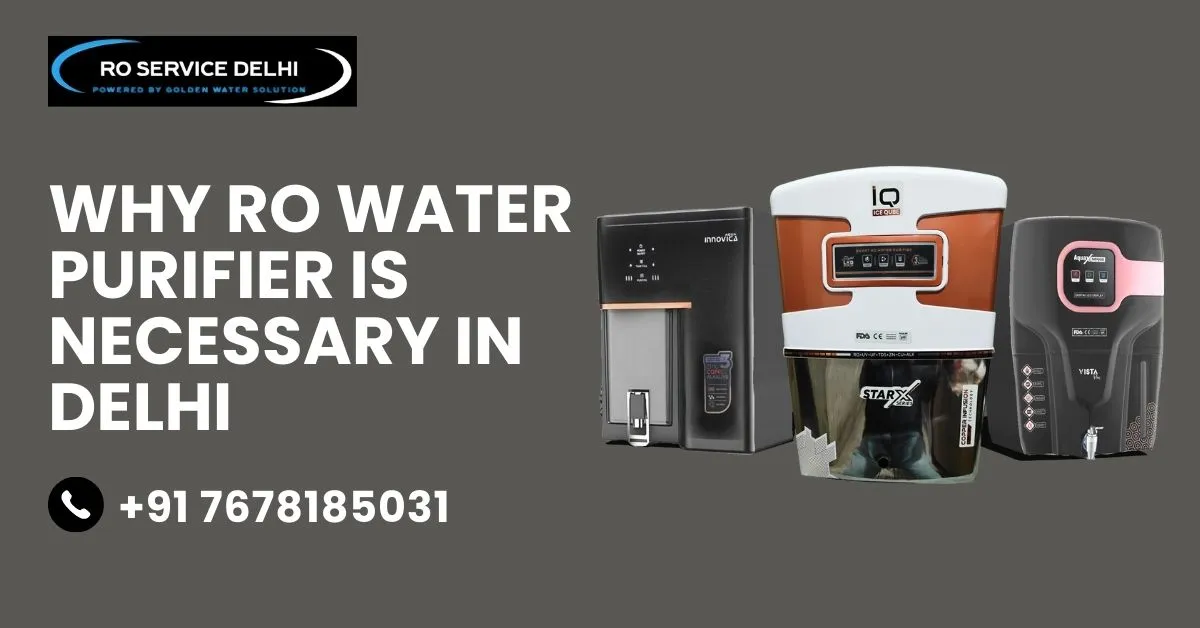
An inquiry into the health and wellness of the 2026 capital city of India has always begun with a simple question of whether Delhi's tap water is safe to drink. Due to the growing rate of urbanization and the growing industrial pressure, the water flowing to our homes has changed considerably. To a majority of households, the possession of an RO water purifier in Delhi has become not just a luxury but a basic need for life. The reason is that, whether you reside in the high-rise of Dwarka or the bustling Laxmi Nagar, the impurities within the water supply, be it in the levels of high dissolved solids or the chemicals within it, make an average filter inadequate. It is essential to understand the need for having an RO water purifier in Delhi to enable families to protect themselves against long-term health consequences of using contaminated water.
Why Delhi’s Water Quality Is a Serious Concern?
Environmentalists and health experts have been involved in a bitter debate over the current state of water in Delhi. Recent audit findings in early 2026 have indicated that much of the water supply of the city is not up to the safety standards laid down by the Bureau of Indian Standards (BIS). The quality of tap water in Delhi is largely impacted by the old infrastructure, where the old, rusted pipelines seep through into the clean water supply in the pipelines, sewage, and industrial wastes.
In addition, the city depends greatly on the Yamuna River, which is often subjected to the ammonia surges that close the treatment plants. Municipal supply is not enough, and the residents resort to groundwater, which is also associated with some challenges. This combination of untrustworthy surface water and infected groundwater necessitates the existence of an RO water purifier in each of the Delhi kitchens.
Why a RO Water Purifier Is Needed in Delhi?
RO is required in Delhi due to a number of technical and health-related reasons. As opposed to basic gravity filters or UV purifiers, Reverse Osmosis (RO) technology is tailored to address the exact cocktail of such contaminants present in the water in the capital.
High TDS Levels in Delhi Water
The Delhi water TDS level is the most prevalent problem the residents encounter. TDS or Total Dissolved Solids is an inorganic salt and small quantities of organic matter that are dissolved in water. Although drinking water should not have a TDS more than 300 ppm, in most of the places, the TDS is recorded to be above 800, and in some instances, it is recorded to be above 1500. The only method that can help to reduce these levels in high TDS water is an RO purifier, which can remove particles as small as 0.0001 micron, so that the water will have a fresh taste, and will be safe on your kidneys.
Groundwater Contamination in Delhi
Owing to the scarcity of water, most of the colonies rely on borewells. The quality of groundwater in Delhi has been exhausted over the years, such that there is an increased level of heavy metals, such as lead, fluoride, and even arsenic, in some belts. Such substances are not colored or odorous, yet may lead to serious neurological and developmental problems in the long run. This is one of the main reasons why RO is required in Delhi, since it is especially aimed at such dissolved chemical threats that a normal UV filter cannot detect.
Hard Water & Scaling Problems in Delhi Homes
The hard water problem in Delhi is being experienced when you see that the taps you have have white crusty deposits on them, or when your soap is not lathering well. Not only do your skin and hair get affected by high levels of calcium and magnesium,m but also your costly kitchen appliances are destroyed. In Delhi, the usage of an RO water purifier is required, which helps in softening the water by eliminating these extra minerals, and this helps to avoid scaling in the purifier itself, and it also gives the water a good taste.
Industrial & Sewage Pollution Impact
The industrial parts of Delhi release effluents that usually enter the water table. Nitrates and phosphates released as a result of agricultural runoff and wastes released as a result of sewage are common pollutants. To provide high-quality drinking water in Delhi, a multi-purification step with an RO membrane to prevent the penetration of these complicated molecules is required.
Area-Wise Water Quality in Delhi & RO Requirement
The necessity of purified water to be used in homes in Delhi differs according to which area of the city one lives in. The following is a breakdown of the water issues of various zones:
South Delhi (Saket, Malviya Nagar, Greater Kailash)
The water in South Delhi is a blend of Sonia Vihar (Ganga water) and the tube wells locally available. Although the city supply is comparatively superior, the water TDS level in the area tends to maintain a range of 400-700 ppm (Delhi). To balance the minerals appropriately, an RO system that has a TDS controller is suggested.
West Delhi (Dwarka, Janakpuri, Uttam Nagar)
The situation of water in West Delhi is one of the worst. The quality of groundwater in the western sub-cities, such as Dwarka in Delhi, is mostly brackish, and the TDS concentrations on many occasions exceed 1000 ppm. In this case, a high TDS water RO purifier is necessary to render the water potable.
North Delhi (Rohini, Pitampura, Model Town)
The residents of North Delhi usually have to work with a "mixed supply. The reliance on borewell water also grows during summers, resulting in the fact that the hardness grows. A domestic water purifier in these regions of Delhi should have a powerful RO membrane to meet the seasonal variation in the quality of water.
East Delhi (Laxmi Nagar, Preet Vihar, Mayur Vihar)
Biological contamination is likely to occur in East Delhi because of old and interconnected pipelines. Where UV works well with bacteria, chlorine, and dissolved impurities are high, an RO water purifier is needed to be used in the eastern parts of Delhi to be absolutely safe.
Central Delhi (Karol Bagh, Patel Nagar, Rajendra Nagar)
The last mile of connection with old pipes, even in Central Delhi, where the supply is more stable, presents lead and rust. At this, professional RO services in Delhi are often demanded to wash filters that are clogged with sediment through such aging lines.
RO vs UV vs UF – Which Water Purifier Is Best for Delhi?
The selection of the best water purifier to use in Delhi involves knowledge of the various technologies.
- UV (Ultraviolet): Eliminates bacteria and viruses but does not eliminate dissolved solids and chemicals.
- UF (Ultra-Filtration): This is used to remove physical suspended particles and certain bacteria, although it does not alter the TDS.
- RO (Reverse Osmosis): The most detailed solution. RO is the gold standard to treat the water of Delhi as it works with TDS, heavy metals, and chemicals.
A combination of RO vs UV of the Delhi water (RO+UV+UF) system is the most rational decision in most of the Delhi houses. It not only guarantees that the water is germ-free but also chemically pure and tastes good.
How to Choose the Best RO Water Purifier for Delhi?
In seeking the solution to the best water purifier in Delhi, one should not consider only the brand name. Follow these steps:
- Check TDS First: Your tap water TDS has to be checked by a digital TDS meter before you purchase. Once it is greater than 500 ppm, it is certainly time to install an RO system.
- Find a TDS Controller: It is essential that a Mineralizer or TDS Controller can eliminate all minerals. It replenishes the necessary mineral such as Calcium and Magnesium to make the water healthy.
- Check Filter Life: Since there are high levels of sediment, inquire about the RO filter life under the conditions of Delhi. Good-quality sediment filters are necessary.
- Service Availability: Make sure that there is a good RO service in Delhi under your preferred brand, since the level of pollution in the city is very high; you will be required to have regular service.
RO Installation & Service in Delhi – Why Professional Help Matters
The purifier only begins with installation. Due to the harshness of the water, maintaining the RO in Delhi is an important aspect of owning it. The silt and salt are high; as a result, the pre-filter would be choked frequently. Not only is the replacement of filters, but a professional RO service in Delhi will also inspect the health of the membrane and the pressure of the pump.
Not adhering to regular service may result in a decrease in water quality, which implies that the RO water purifier in Delhi will become weaker with time. The majority of specialists suggest that the RO filter life in Delhi should be prolonged to the maximum so that the service check would be periodically done in 6 months to be sure that the water is 100 percent safe.
Conclusion
In a city where the environment is continuously put to the test, it is in the nature of things that when you are at home, and you take the water you drink, you are controlling your health. The signs are evident: among the increased industrial contaminants on the one hand, and the natural abundance of natural minerals in the ground, on the other hand, a RO water purifier is needed in Delhi in every house, which considers the future long-term well-being. With the appropriate selection of the system and proper RO maintenance in Delhi, you will be able to enjoy the peace of mind of having pure and safe glass of water.
Frequently Asked Questins
Q1. Is RO water safe for daily drinking in Delhi?
Ans. Yes, but you would have to purify it with a TDS controller. The water quality and contamination of the water in Delhi are high; the best solution to eliminate the toxic heavy metals and high salt levels is by using RO.
Q2. Can a UV purifier work in Delhi water?
Ans. The use of a UV purifier is only effective when the TDS is steadily below 300 ppm, and there are no heavy metals. Under the present state of the tap water in Delhi, most households will not be satisfied with a UV-only system.
Q3. How often should RO be serviced in Delhi?
Ans. Because of the high impurities and the hard water issue in Delhi, it is advisable that RO maintenance in Delhi should be taken after every 3 to 4 months. The pre-filter should be cleaned on a regular basis to help prolong the life of the costly RO membrane.
Q4. What happens if TDS is too high?
Ans. Consumption of water that has a high level of TDS in Delhi water (more than 1000ppm) will result in a salty taste, digestive disturbances, and the probability of developing kidney stones. It also renders the water heavy and distasteful to drink.
Trusted RO Service Provider in Delhi Since 2011. Our team understands that a functional water purifier is essential for your family's health. Whether you need routine maintenance or urgent repairs, we are the go-to Ro Service Delhi provider.